
Overview
The August 2026 monthly funding report shows a more restrained month for venture investment, with $44.7 billion raised across 502 deals, compared with $58.6 billion across 525 deals in July. Deal volume declined only 4%, while total funding fell almost 24%, indicating that the main change came from smaller financing amounts rather than a broad collapse in investment activity. Series B was the strongest traditional round, while Series A and Series D recorded the most noticeable declines.
| Round | Amount July (USD) | Number deals July | Amount August (USD) | Number deals August |
|---|---|---|---|---|
| Pre-seed funding | 183,425,000 | 54 | 168,965,300 | 56 |
| Seed Round | 1,758,750,570 | 150 | 1,324,013,500 | 147 |
| Series A | 6,425,310,000 | 143 | 4,363,930,000 | 96 |
| Series B | 4,594,840,000 | 61 | 5,387,968,000 | 66 |
| Series C | 6,915,040,000 | 30 | 5,343,477,000 | 34 |
| Series D | 5,501,860,000 | 20 | 3,642,600,000 | 15 |
| Series E | 2,123,500,000 | 3 | 891,000,000 | 7 |
| Other | 31,096,855,170 | 64 | 23,600,146,700 | 81 |
| Total | 58,599,580,740 | 525 | 44,722,097,500 | 502 |
Funding Activity by Number of Deals
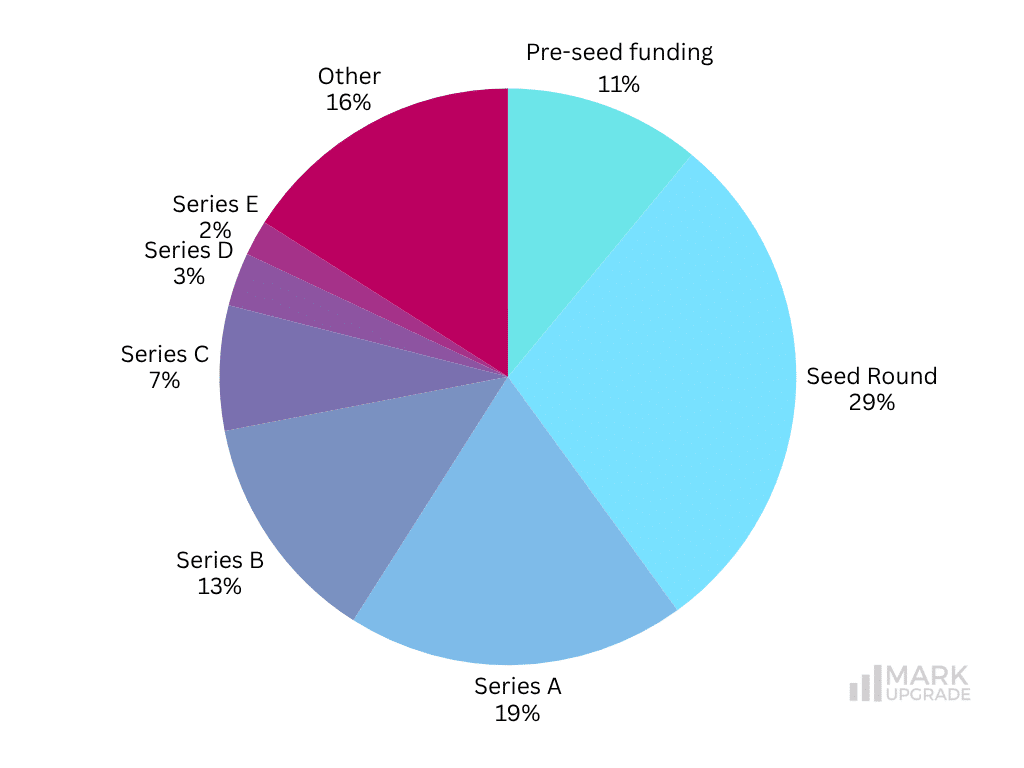
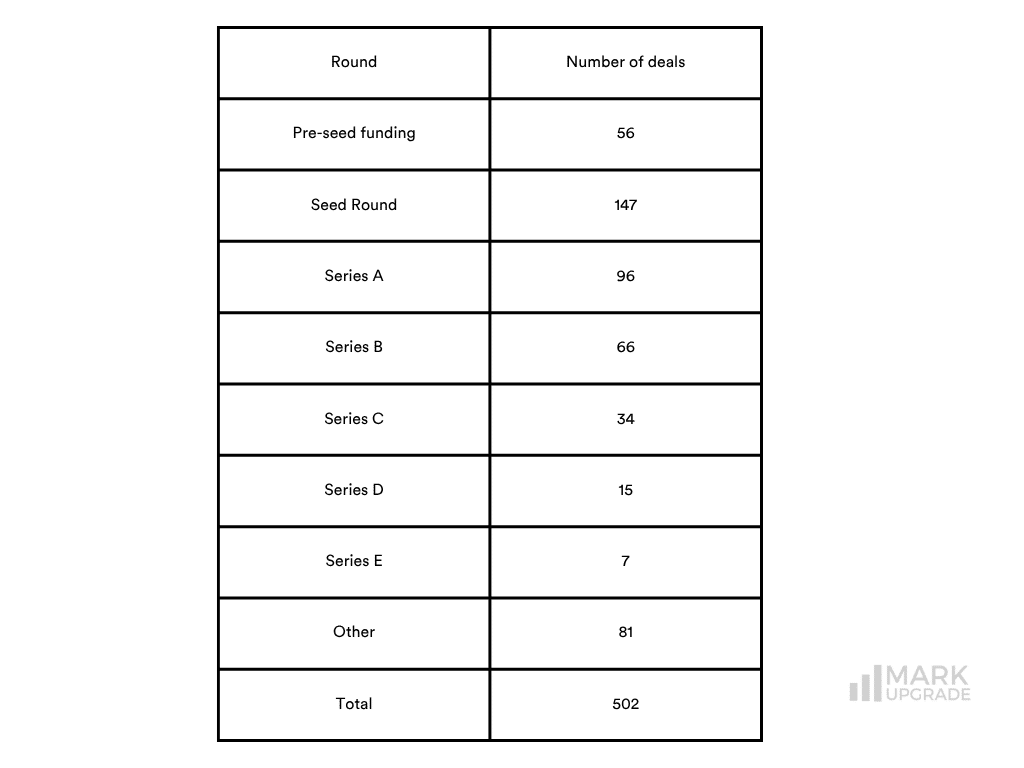
August recorded 502 funding deals, slightly below July’s 525, but the movement varied considerably between stages.
Key observations
- Series A fell sharply from 143 to 96 deals, the largest decline among the major stages, pointing to greater selectivity around companies moving beyond seed.
- Seed remained relatively stable, slipping only from 150 to 147 deals, while pre-seed increased slightly from 54 to 56, showing continued interest at the earliest stages.
- Series B increased from 61 to 66 deals, while Series C rose from 30 to 34, indicating stronger activity among companies with established traction.
- Series D declined from 20 to 15 deals, suggesting fewer large later-stage transactions at this level.
- Series E increased from 3 to 7 deals, although the small base means the rise should be viewed cautiously.
- Other Funding Rounds climbed from 64 to 81 deals, showing more activity outside the standard venture stages and helping offset declines elsewhere.
Funding Distribution by Round
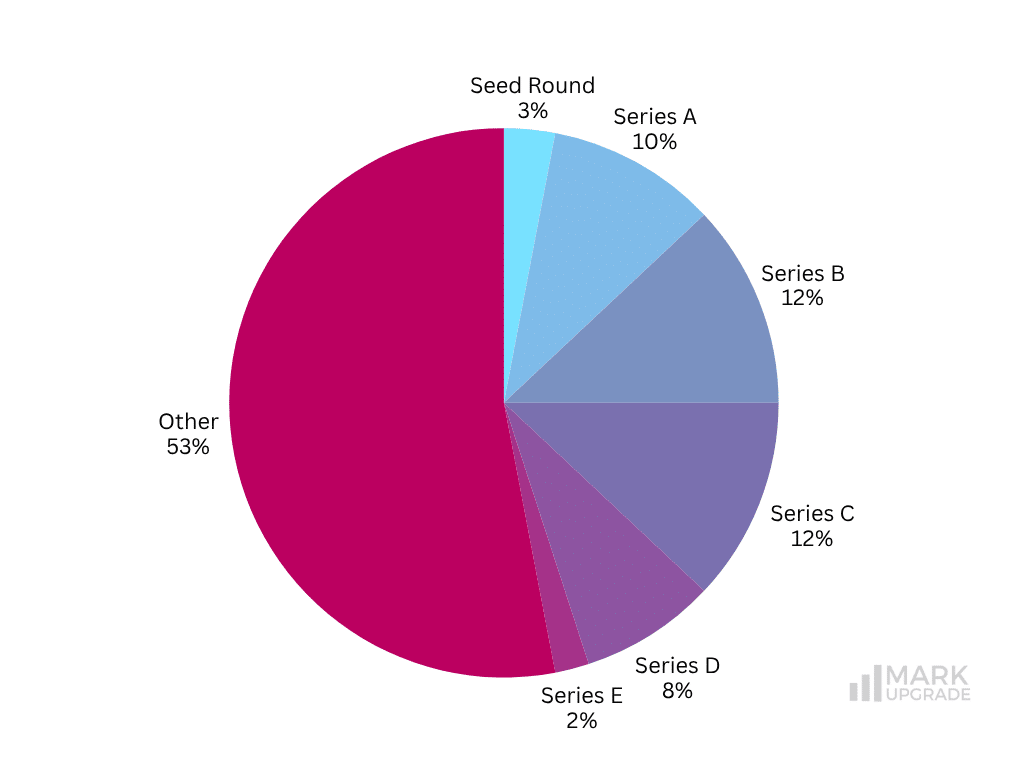
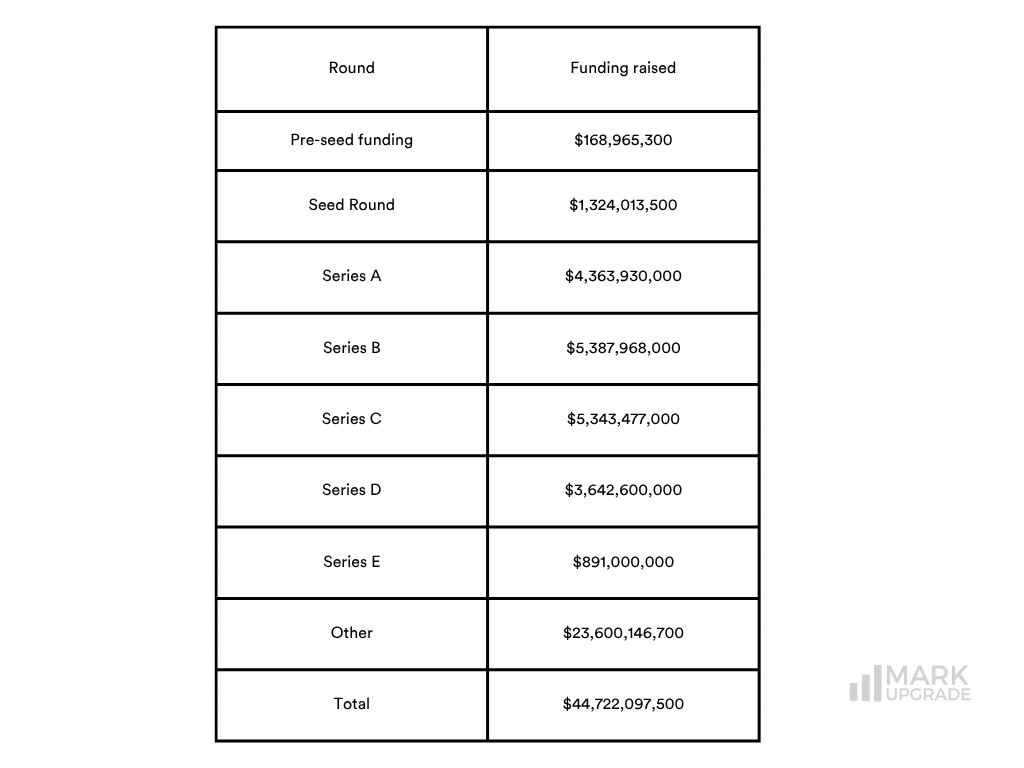
Total monthly funding fell to $44.7 billion from $58.6 billion in July, with lower capital deployment across most stages. The largest startup funding deal in August went to Databricks, which raised $5 billion at a $190 billion valuation.
Key observations
- Series B was the main growth category, increasing from $4.59 billion to $5.39 billion, alongside a rise in deal count. Investors continued to commit substantial capital to companies that had already demonstrated commercial traction.
- Series A funding fell 32% to $4.36 billion, broadly matching the decline in deal volume and marking one of the clearest signs of greater caution in August.
- Series C funding declined from $6.92 billion to $5.34 billion despite more deals, suggesting capital was spread across a larger number of smaller rounds.
- Series D dropped from $5.50 billion to $3.64 billion, reflecting both fewer transactions and reduced capital deployment at the later growth stage.
- Series E fell sharply from $2.12 billion to $891 million even as deal count more than doubled, indicating considerably smaller average round sizes.
- Seed funding declined from $1.76 billion to $1.32 billion, while deal numbers remained almost unchanged, again pointing to smaller individual financings.
- Other Funding Rounds fell from $31.1 billion to $23.6 billion, even though the number of deals increased from 64 to 81. The pattern reinforces the broader August trend: more transactions in some categories, but less capital concentrated in each deal.
Political & Economic Influence (Global)
August brought several developments with direct implications for investment markets. The IEA reported on 12 August that 8.3 million barrels per day of Gulf oil production remained offline, following renewed Middle East hostilities and disruption around the Strait of Hormuz. North Sea crude was trading at roughly $92 a barrel, and the IEA cut its 2026 global oil supply forecast, increasing concerns around energy costs and inflation.
Economic signals were mixed elsewhere. China’s manufacturing PMI fell to 49.2 in July, data released at the start of August, putting manufacturing back into contraction. In Europe, conditions were stronger: the Eurozone Composite PMI reached 52.1 in August, its highest level since November, supported by an improvement in manufacturing, particularly in Germany.
Trade policy also remained in focus. The EU suspended planned retaliatory trade measures against the U.S. from 7 August, reducing one source of transatlantic uncertainty, while geopolitical and energy disruptions continued to affect global supply chains.
Impact on funding
Higher energy costs and weaker signals from China added reasons for investors to remain selective, while stronger European business conditions provided some counterbalance. The combination helps explain an environment where capital remained available but was concentrated in companies with strong growth prospects or exposure to strategic sectors such as AI, energy, defense and infrastructure, rather than being distributed evenly across the market.
Political & Economic Influence (U.S.)
U.S. data released during August presented investors with a difficult mix of slower employment growth and persistent inflation. The 7 August jobs report showed that payrolls fell by 23,000 in July, while previous estimates for May and June were revised down by a combined 103,000 jobs. Unemployment remained at 4.1%.
Inflation data released five days later showed CPI running at 3.4% year over year, still well above the Federal Reserve’s 2% objective, although core inflation eased to 2.5%. The Fed therefore entered August with its policy rate unchanged at 3.5% to 3.75%, and minutes released on 19 August showed continued concern over inflation and Middle East driven energy pressures.
Technology investment remained a major exception to the softer backdrop. At Jackson Hole on 28 August, Fed Chair Kevin Warsh said business investment in equipment and intangible assets was growing at around 9%, the fastest pace since 2021, with more than half of that growth likely attributable to the AI buildout.
Industrial policy reinforced the focus on strategic technology. During August, the administration announced new measures supporting domestic polysilicon production and tariffs on imported drones and components, linking trade policy more closely with energy, semiconductor and defense supply chains.
Impact on funding
Weak employment data increased concerns about economic growth, while inflation above target kept borrowing costs elevated and limited the prospect of rapid monetary easing. That combination favoured more selective venture deployment. At the same time, exceptionally strong AI capital expenditure and government support for strategic industries continued to attract large investments into AI infrastructure, defense, energy and advanced technology, helping explain why major rounds continued even as overall August funding declined.
Key Investment Sectors in August 2026
Artificial intelligence remained by far the most prominent sector in August, appearing across software, cybersecurity, healthcare, fintech, manufacturing, robotics, telecommunications and data infrastructure. Beyond AI, recurring areas of investment included energy, transportation and logistics, fintech and financial services, biotechnology and healthcare, defense and aerospace, cybersecurity, and robotics. The spread shows that investors continued to favour technologies tied to automation, infrastructure, security and long-term industrial demand, while life sciences and financial technology remained important parts of the funding landscape.
Domain Name Highlights
.com remained the dominant extension, used by 319 of 502 companies, or 64%, underlining its continued strength as the most familiar and widely recognised choice for businesses building across markets.
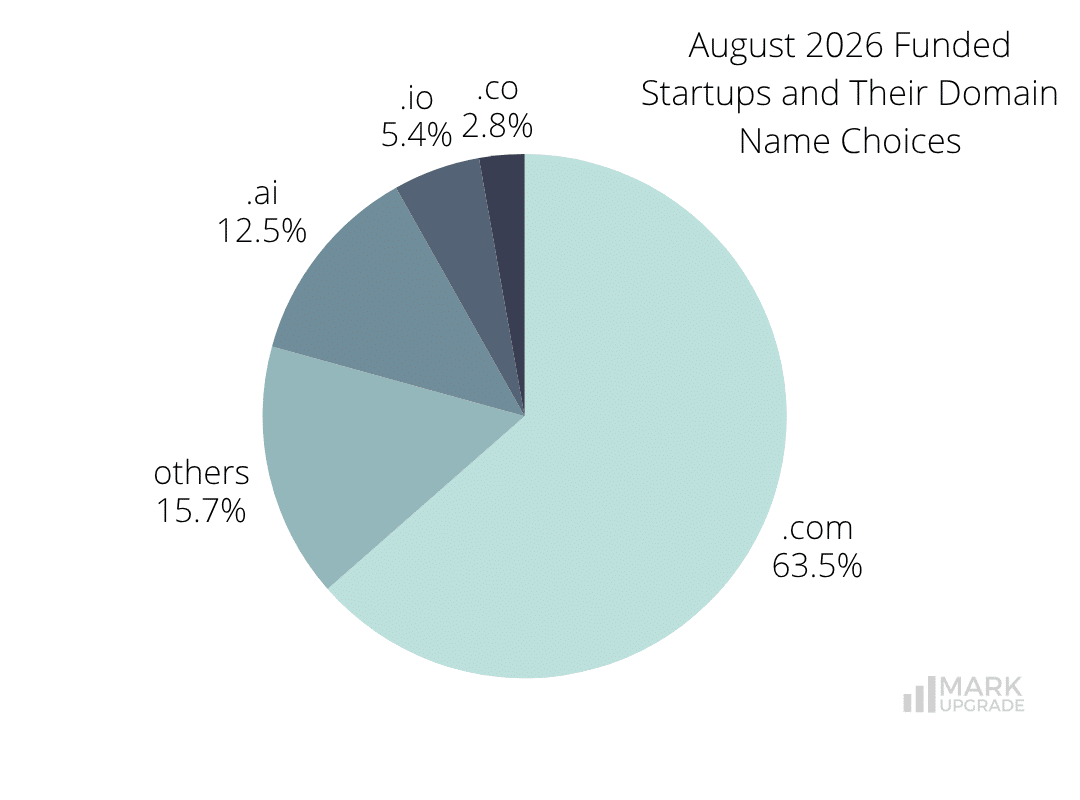
.ai was used by 63 companies, or 13%, reflecting continued demand from AI startups, although the extension can become limiting for companies that later move beyond an AI-focused identity.
.io accounted for 27 companies, or 5%, remaining established within technology circles but offering less mainstream recognition than .com.
.co was used by 14 companies, or 3%, providing a short alternative but carrying a greater risk of users instinctively navigating to the corresponding .com.
Other extensions represented 79 companies, or 16%, showing continued experimentation with newer and sector-specific domain endings, which can require more effort to build recognition.
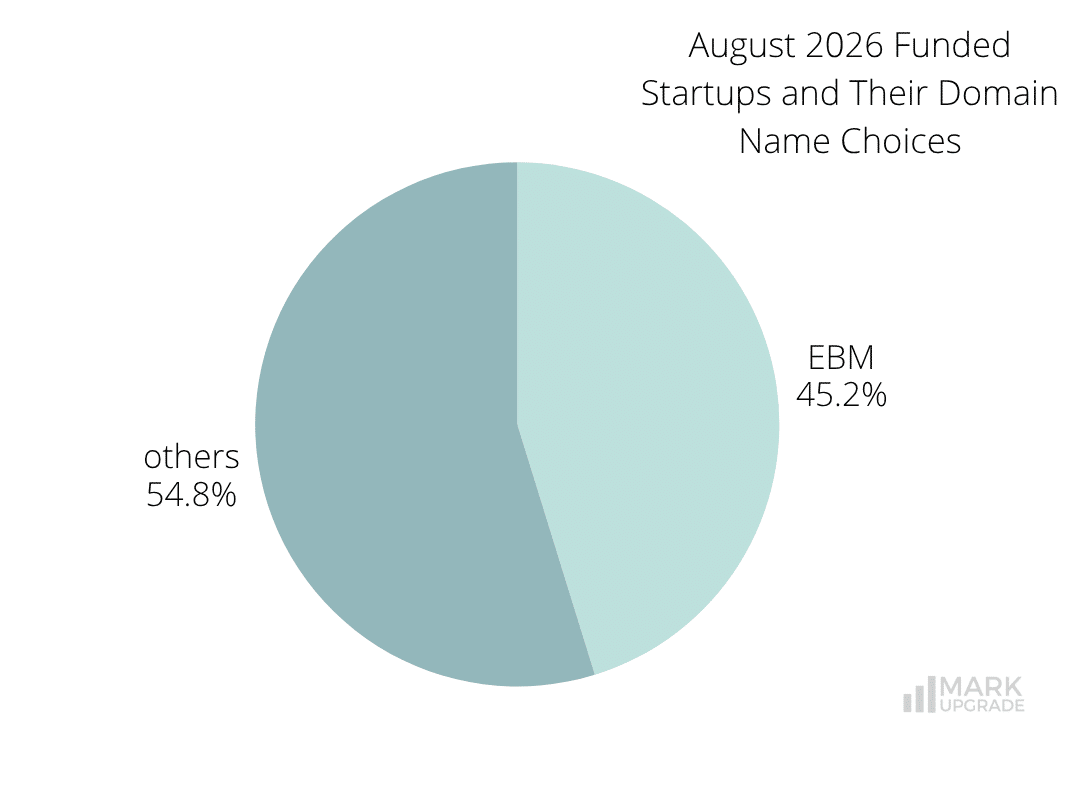
227 companies, or 45%, operated on an Exact Brand Match (EBM) domain name, giving them a direct match between company name and domain that supports memorability, trust, and reduces the risk of traffic or email leakage.
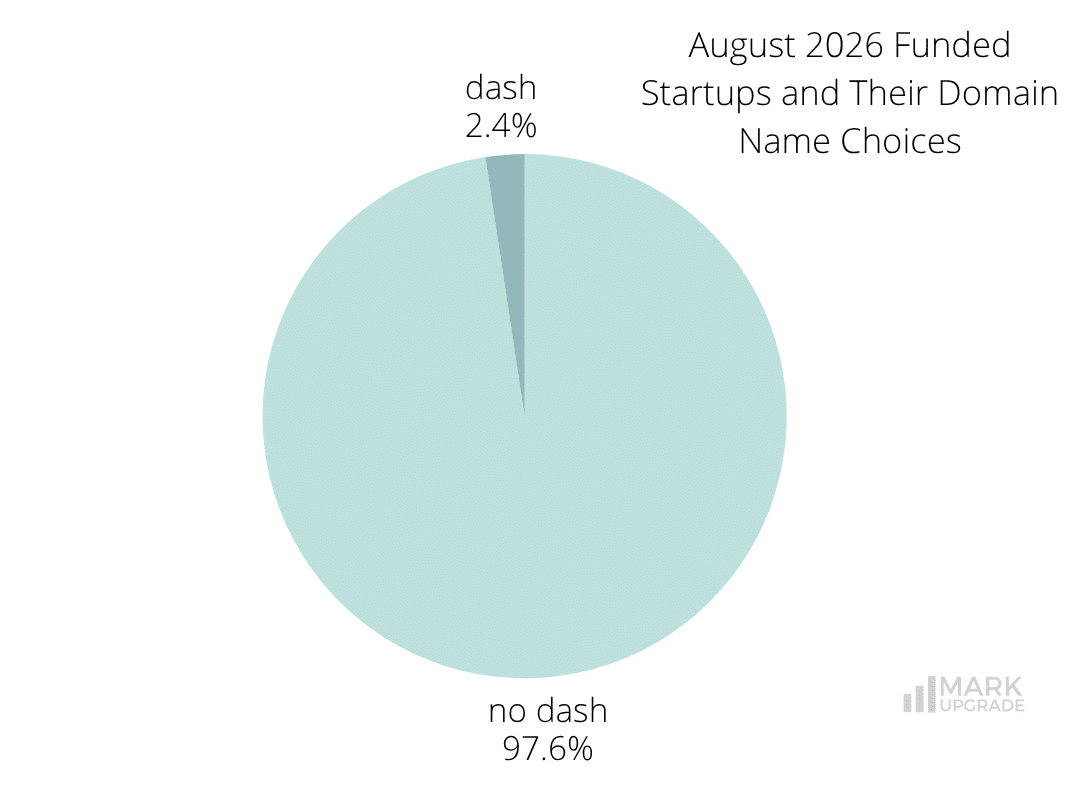
Only 12 companies, or 2%, used a hyphenated domain name, suggesting founders continue to favour simpler names that are easier to remember, type, and communicate verbally.
Company Spotlights
Lovable
Industry: AI
Funds Raised: $400,000,000 Series C
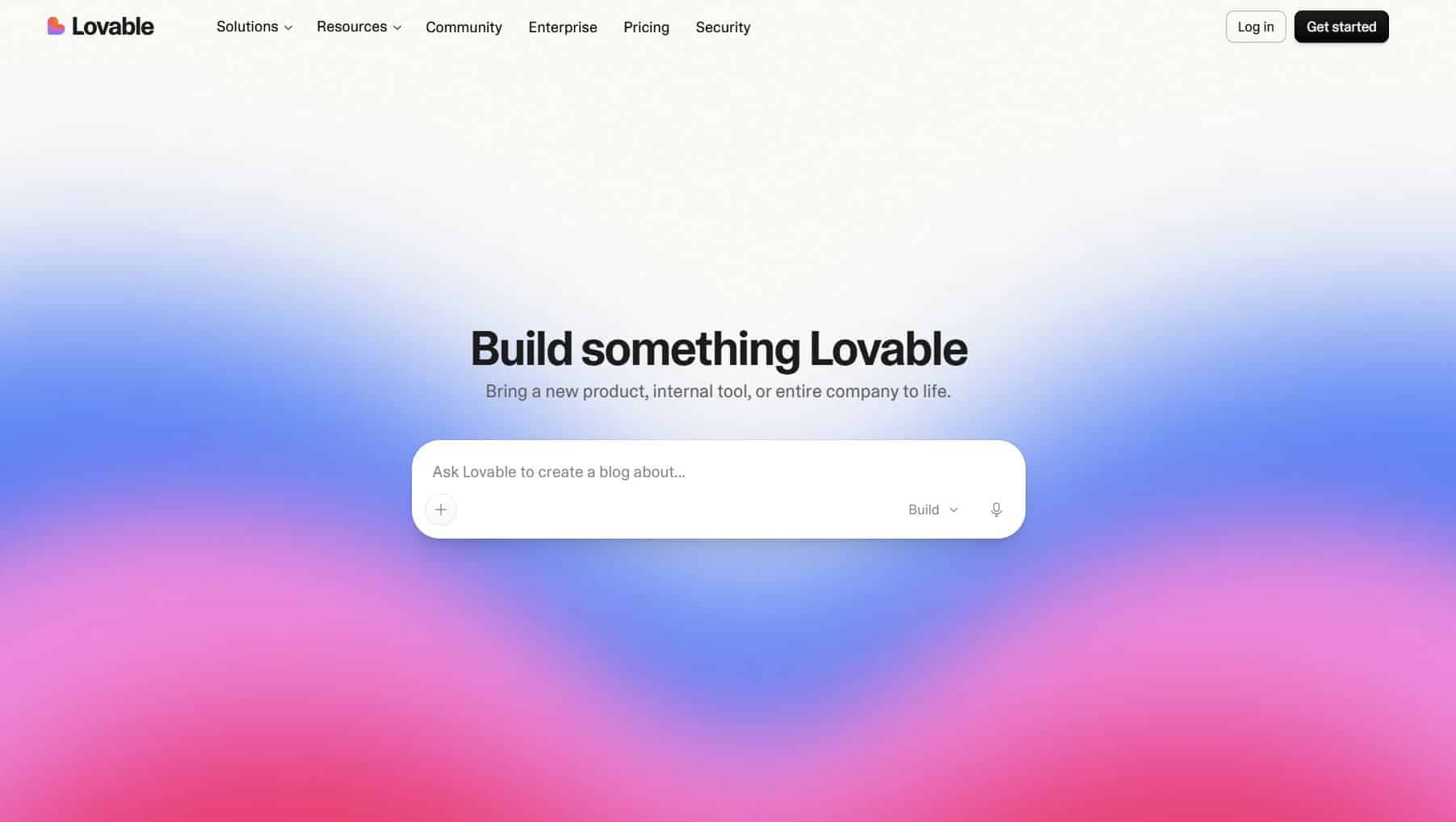
Lovable is an AI software platform that allows users to build applications using natural language, making software creation accessible to people without traditional coding skills. The new funding will support continued product development, infrastructure, and global expansion as the company scales its platform.
The name Lovable gives the company a distinctive identity in a highly technical category. It is simple, memorable, and broad enough to support the business as it expands beyond its original developer-focused positioning.
The company also strengthened its digital identity by upgrading from Lovable.dev to Lovable.com, securing the exact brand match .com for its name. The move gives Lovable a more intuitive global domain, reduces potential traffic and email leakage, and provides greater flexibility as the company grows. We covered the upgrade in From Lovable.dev to Lovable.com: Closing the Most Obvious Gap.
Callosum
Industry: AI
Funds Raised: $100,000,000 Seed Round
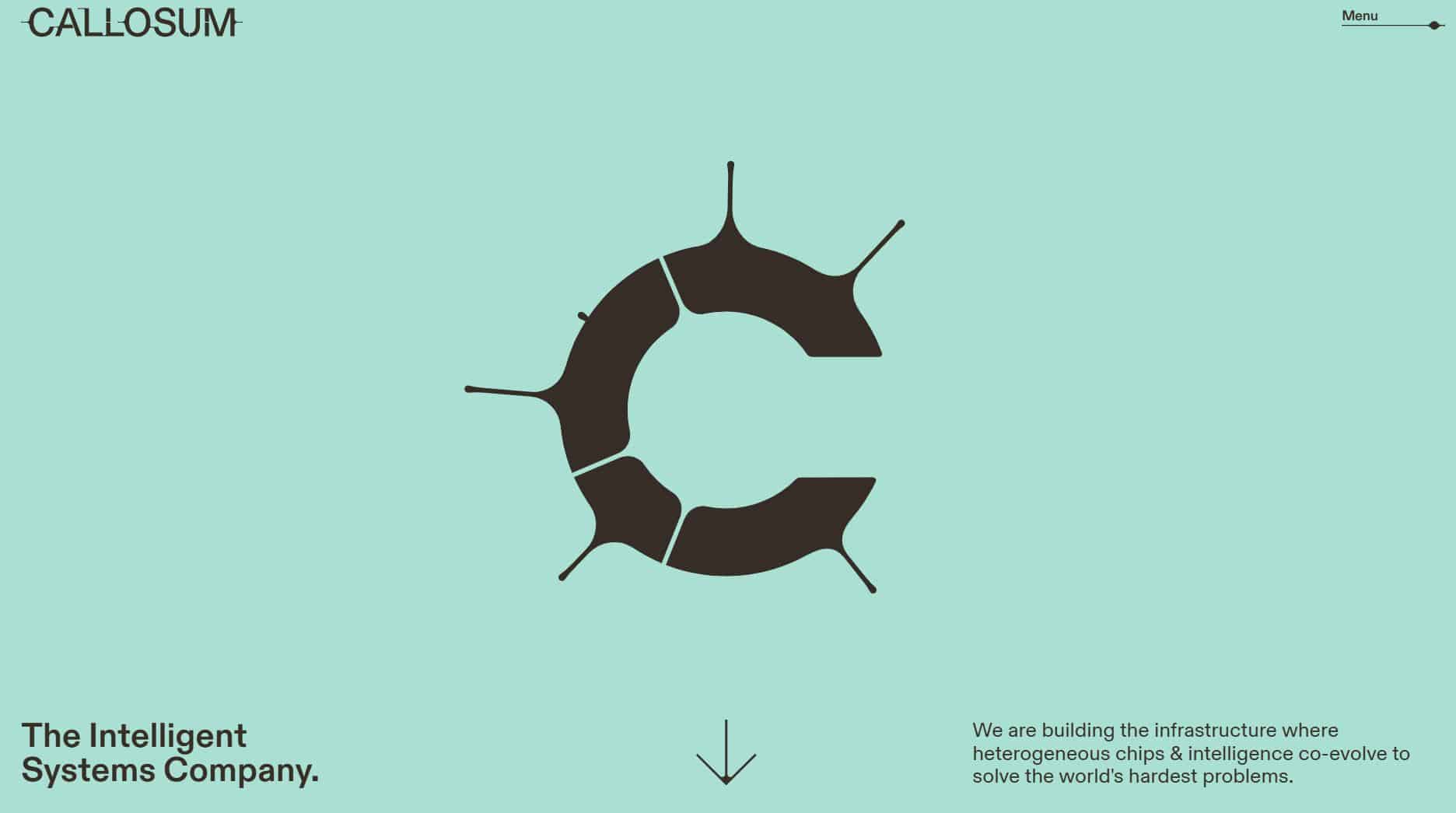
Callosum is building infrastructure that allows different AI models and chip architectures to work together as one system. Its platform matches workloads with the most suitable hardware, with the aim of improving performance and reducing the cost of AI computing. The $100 million seed round, led by Atomico with participation from Plural, DCVC and the UK Sovereign AI Fund, will support product development, expansion of its compute platform and partnerships across the AI hardware ecosystem.
Callosum brand name draws on the corpus callosum, the structure connecting the brain’s two hemispheres. The reference suits a company focused on linking different forms of compute and intelligence into one system.
Callosum operates on Callosum.com, an Exact Brand Match (EBM) domain name. The matching .com supports recognition, credibility, and consistency as the company works with customers and partners across global technology markets.
Castelion
Industry: Aerospace, Government, Manufacturing
Funds Raised: $1,000,000,000 Series C
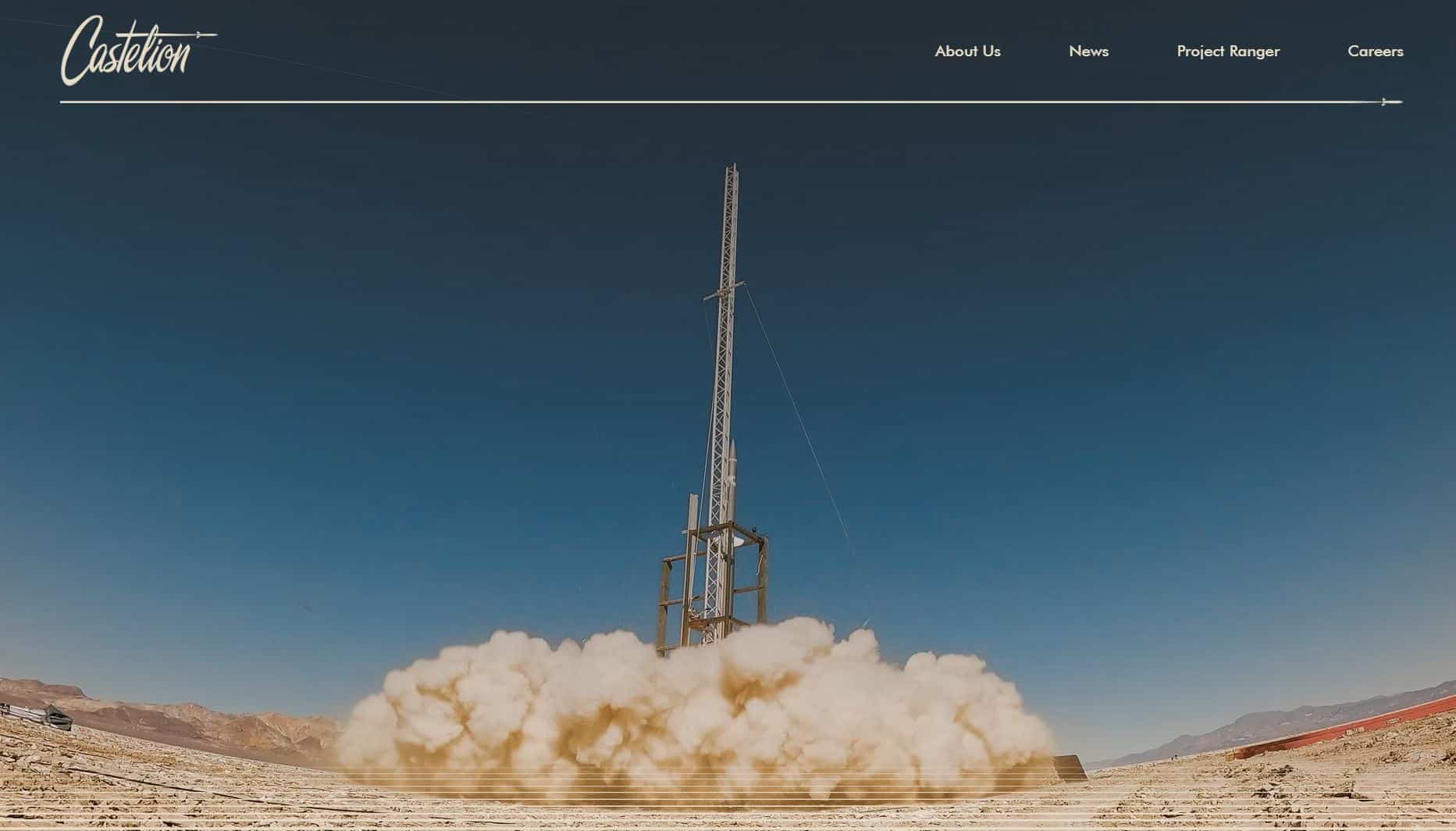
Castelion develops low-cost hypersonic weapons and other advanced defense systems designed for rapid, high-volume production. The Series C will help scale production of its Blackbeard hypersonic missile, expand manufacturing capacity in New Mexico, and accelerate development of longer-range strike and defensive systems. The round values the company at $13 billion.
Castelion was founded in 2022 by former SpaceX executives with a focus on making advanced defense hardware faster and at lower cost than traditional programs. Its mission and product names, including Blackbeard, give the company a distinctive identity in a sector where naming is often highly technical or institutional.
Castelion operates on Castelion.com, an EBM domain name. Matching the company name with the global .com extension supports recognition and credibility, while also reducing the risk of traffic or email confusion as the business expands across government, defense and manufacturing markets.
Etched
Industry: AI
Funds Raised: $700,000,000 Venture Round
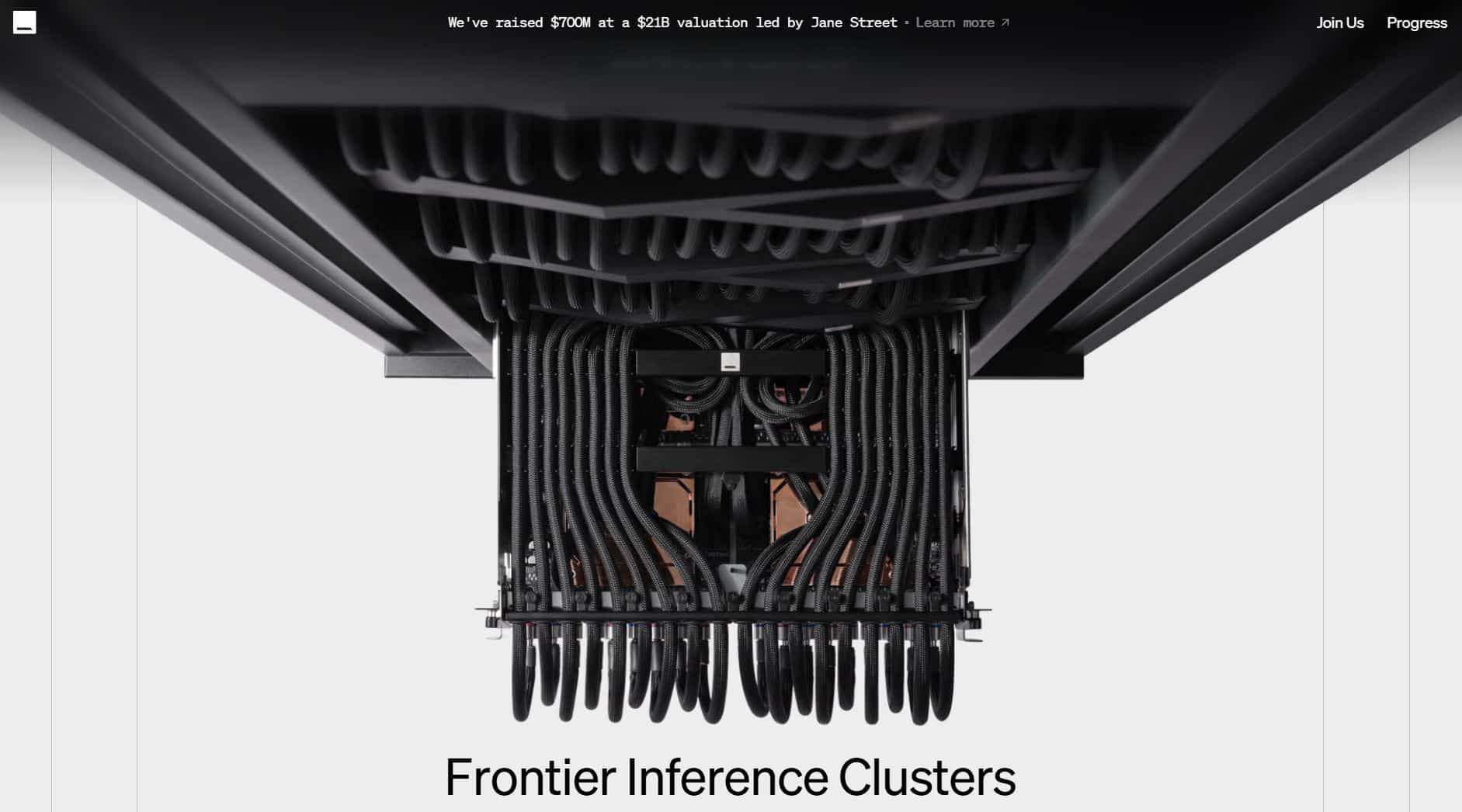
Etched builds specialised hardware for AI inference, combining chips, racks, software and manufacturing into what it calls frontier inference clusters. The company says its systems are designed to run advanced AI models with higher throughput and lower cost and power use. The new funding will support production at much larger scale, including new factories, global supply chains and software for managing its hardware.
One detail stands out: Etched had raised a $300 million Series C at a $10.3 billion valuation in July, then raised another $700 million at a $21 billion valuation in August, effectively doubling its valuation in less than a month. Jane Street led the latest round after testing the hardware and became Etched’s first customer.
Etched.com is an EBM domain name built around a short dictionary word. The name is distinctive for a semiconductor company and works well with the idea of circuits being etched into silicon, while the matching .com gives the company a memorable and globally recognisable identity.
Lumilens
Industry: AI, Telecommunications
Funds Raised: $700,000,000 Series C
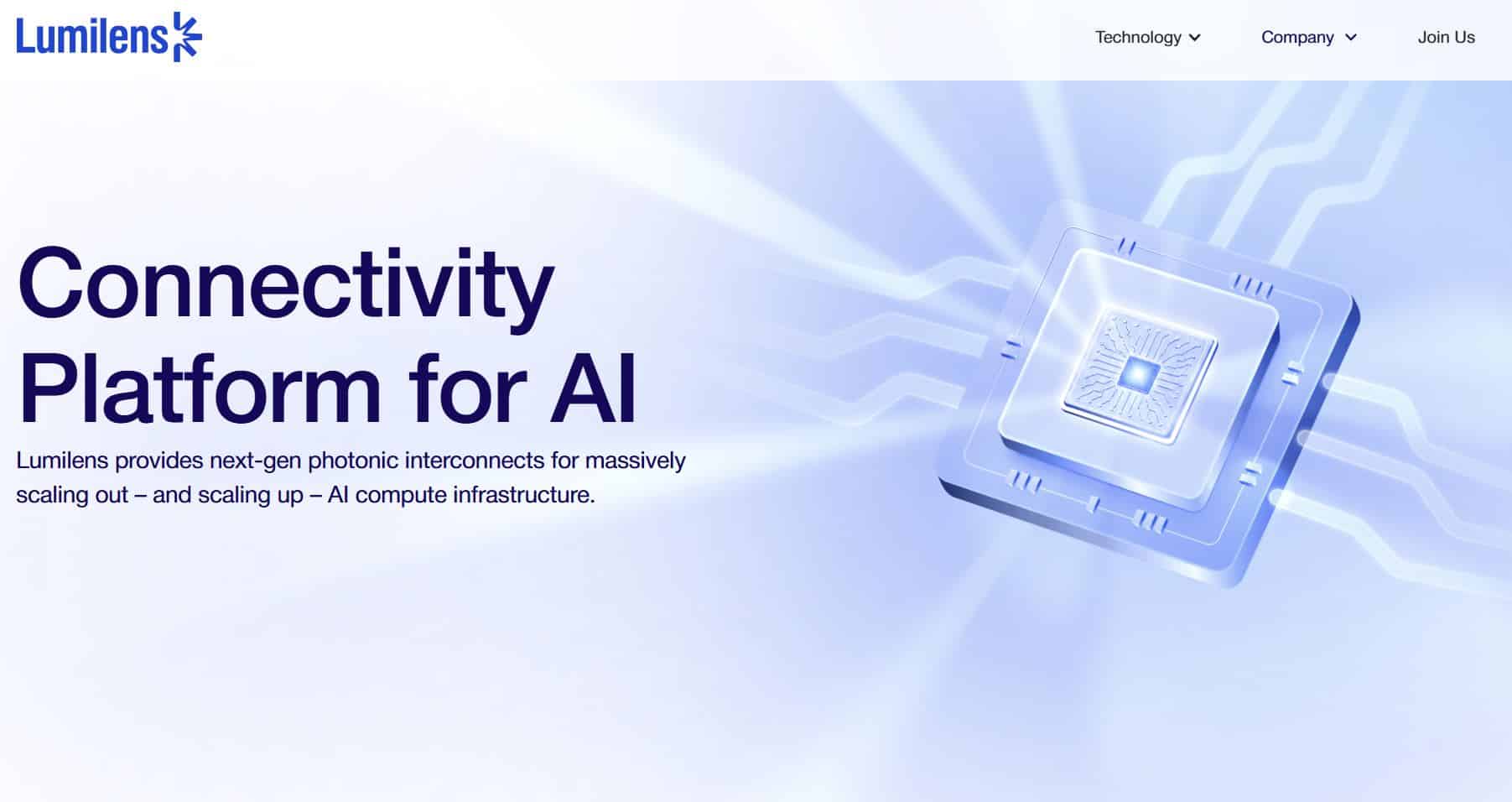
Lumilens develops photonic interconnect technology for AI data centres, replacing traditional electrical connections with optical links that can move data between GPUs and servers at much higher speeds. The company emerged from stealth in August with more than $900 million raised in total and is already shipping products under a multi-billion-dollar customer agreement.
The Series C will support expansion across silicon, systems, software, process engineering and high-volume manufacturing as Lumilens scales production for hyperscale AI infrastructure.
Lumilens combines associations with light and optics, fitting naturally with a company built around photonics. The company operates on Lumilens.com, an EBM domain name, giving it a direct, memorable identity as it expands across global AI infrastructure markets.
The right domain name is an important consideration when it comes to building and protecting your brand. If you’re ready to take the next step and invest in a perfect domain name for your business, contact us to learn more about our available options and how we can help you get started.

Other resources
august branding business domain name domain names domains funded funding naming
Previous Next